Saturday, May 3, 2014

BODHIDHARMA (FOUNDER OF KUNG FU)

Bodhidharma (Founder of Zen Buddhism and Shaolin Kung Fu)

Bodhi Dharma(போதிதர்மன்) also known, Da Mo, Bodhitara, P’u-t’i Ta-mo, Ta-mo, Bodai Daruma, and Daruma was born in Kanchi in the Southern Indian kingdom (today’s Tamil Nadu State ) of Pallavaaround year 440. Bodhi Dharma was the youngest of three brothers in the royal family of the southern Indian kingdom of Pallava king SugandanHis father, the king Sugandan, also known as Simhavarman was a devoted Buddhist and managed state affairs according to the Buddha’s teachings. At birth Bodhi Dharma was born with a breathing disorder. He was adopted and trained at birth in breathing exercises and combat, namely in the arts of Dravidian warfare arts of Southern India and self-defense techniques such Kuttu Varisai and Pidi Varesai (Punches Series- hand to hand combat with animal styles and locking techniques Similar to Kung Fu and Karate), Malyutham (grappling), Varma Kalai (Secret or Vital Art, Pressure point attacks, In healing and Self-defense similar to Tai Chi or Dim Mak), Silambam (staff fighting), Eretthai or Saydekuche (double stick fighting), Madhu or Madi (deer horn weapon fighting), Surul Pattai or Surul wall (steel blade whip), Val Vitchi (single sword), and Eretthai Val (double short sword) fighting.Bodhidarma also studied Dhyana Buddhism and became the 28th patriarch of that religion.
Bodhidharma's statue near Shaolin Temple

Brief Story:

Shaolin monks and disciples follow a unique practice among Buddhists in that they greet each other using only their right hand. This greeting is a tradition which dates back to Bodhidharma and his disciple, Hui Ke.
In 495 AD, the Indian monk Ba Tuo, or Buddhabhadra, came to China teaching a form of Buddhism known as Xiao Sheng Buddhism. He was given land at the foot of Shaoshi mountain by Emperor Shao Wen and founded the Shaolin Temple on this land.
Shaolin Temple, China
Around the time that Ba Tuo was founding the Shaolin Temple there was an Indian prince named Bodhidharma. Bodhidharma was very intelligent and was the favorite son of the king of India. Bodhidharma had two older brothers who feared that their father, the king, would pass them over and bequeath the kingship to Bodhidharma. In their jealousy, the two older brothers often disparaged Bodhidharma while talking with their father, hoping to turn him against their younger brother. The older brothers also attempted to assassinate Bodhidharma but Bodhidharma had very good karma and so the attempts were not successful. Despite being the favorite son of the king, Bodhidharma realized that he was not interested in a life of politics. He chose instead to study with the famous Buddhist master Prajnatara and become a Buddhist monk.
Bodhidharma trained with his master for many years. One day he asked his master, “Master, when you pass away, where should I go? What should I do?” His master replied that he should go to Zhen Dan, which was the name for China at that time. Years later, Bodhidharma’s master passed away and Bodhidharma prepared to leave for China.
During the many years that Bodhidharma had studied as a monk, one of his older brothers had become king of India and that older brother’s son had become king after him. The king of India was very fond of his uncle and wanted to make amends for the actions which Bodhidharma’s older brothers had taken against him. He asked Bodhidharma to stay near the capital, where he could protect and care for him, but Bodhidharma knew that he must go to China as his master had said.
Seeing that Bodhidharma would not remain, the king of India ordered that carrier pigeons be sent to China with messages asking the people of China to take care of Bodhidharma. These messages made Bodhidharma famous among many Chinese who wondered what was so special about this particular Buddhist monk that the king of India would make such a request.
According to Southeast Asian folklore, Bodhidharma travelled from south India by sea to Sumatra, Indonesia for the purpose of spreading the Mahayana doctrine. From Palembang, he went north into what are now Malaysia and Thailand. He travelled the region transmitting his knowledge of Buddhism and martial arts before eventually entering China through Vietnam. Malay legend holds that Bodhidharma introduced preset forms to silat.
In 527 AD, 32 years after Ba Tuo’s founding of the Shaolin temple, Bodhidharma crossed through Guangdong province into China. In China, he was known as Da Mo. Bodhidharma arrived in China practicing Da Sheng (Mahayana) Buddhism. When Bodhidharma arrived, he was greeted by a large crowd of people who had heard of the famous Buddhist master and wished to hear him speak. Rather than speak, Bodhidharma sat down and began meditating. He meditated for many hours. Upon completing his meditation, Bodhidharma rose and walked away, saying nothing.
His actions had a profound effect upon his audience. Some people laughed, some cried, some were angry and some nodded their heads in understanding. Regardless of the emotion, everyone in the crowd had a reaction.
This incident made Bodhidharma even more famous, so famous that Emperor Wu heard of him. Emperor Wu, who ruled over the southern kingdom of China, invited Bodhidharma to come to his palace. When Bodhidharma arrived, Emperor Wu talked with Bodhidharma about Buddhism. The emperor had erected many statues and temples devoted to Buddhism. He had given much wealth to Buddhist temples. In talking of his accomplishments, Emperor Wu asked Bodhidharma if his actions were good. Bodhidharma replied that they were not. This response surprised Emperor Wu, but they continued talking and eventually Emperor Wu asked Bodhidharma if there was Buddha in this world. Bodhidharma replied that there was not.
Bodhidharma’s replies were a reflection of Emperor Wu. By asking if his actions were good, Emperor Wu was searching for compliments and affirmation from Bodhidharma. Bodhidharma denied that Emperor Wu’s actions were good because it is the duty of the emperor to care for his people. Rather than seeking compliments, Emperor Wu should have been content to help his people through Buddha. Similarly, if one asks if there is Buddha in the world, then one has already answered the question: Buddha is a matter of faith, you either believe in your heart or you do not. In questioning the existence of Buddha, Emperor Wu had demonstrated a lack of faith.
Bodhidharma’s answers enraged Emperor Wu and he ordered Bodhidharma to leave his palace and never return. Bodhidharma simply smiled, turned and left.
Bodhidharma continued his journey, heading north, when he reached the city of Nanjing. In the city of Nanjing, there was a famous place called the Flower Rain Pavillion where many people gathered to speak and relax. There was a large crowd of people gathered in the Flower Rain Pavillion around a Buddhist monk, who was lecturing. This Buddhist monk was named Shen Guang.
Shen Guang had at one time been a famous general. He had killed many people in battle but one day realized that the people he had been killing had family and friends and that one day someone might come and kill him. This changed him and he decided to train as a Buddhist monk. Eventually, Shen Guang became a great speaker on Buddhism. As Bodhidharma neared the crowd, he listened to Shen Guang’s speech. Sometimes Shen Guang would speak and Bodhidharma would nod his head, as if in agreement. Sometimes Shen Guang would speak and Bodhidharma would shake his head, as if in disagreement. As this continued, Shen Guang became very angry at the strange foreign monk who dared to disagree with him in front of this crowd. In anger, Shen Guang took the Buddhist beads from around his neck and flicked them at Bodhidharma. The beads struck Bodhidharma in his face, knocking out two of his front teeth. Bodhidharma immediately began bleeding. Shen Guang expected a confrontation; instead, Bodhidharma smiled, turned and walked away.
This reaction astounded Shen Guang, who began following after Bodhidharma.
Bodhidharma continued north until he reached the Yangzi river. Seated by the river there was an old woman with a large bundle of reeds next to her. Bodhidharma walked up to the old woman and asked her if he might have a reed. She replied that he might. Bodhidharma took a single reed, placed it upon the surface of the Yangzi river and stepped onto the reed. He was carried across the Yangzi river by the force of his chi. Seeing this, Shen Guang ran up to where the old woman sat and grabbed a handful of reeds without asking. He threw the reeds onto the Yangzi river and stepped onto them. The reeds sank beneath him and Shen Guang began drowning. The old woman saw his plight and took pity on Shen Guang, pulling him from the river. As Shen Guang lay on the ground coughing up river water, the old woman admonished him. She said that by not asking for her reeds before taking them, he had shown her disrespect and that by disrespecting her, Shen Guang had disrespected himself. The old woman also told Shen Guang that he had been searching for a master and that Bodhidharma, the man he was following, was that master. As she said this, the reeds which had sunk beneath Shen Guang rose again to the surface of the river and Shen Guang found himself on the reeds being carried across the Yangzi river. He reached the other side and continued following after Bodhidharma.
There are many people who believe that the old woman by the river was a Boddhisatva who was helping Shen Guang to end the cycle of his samsara.
Way To Cave
At this point, Bodhidharma was nearing the location of the Shaolin Temple. The Shaolin monks had heard of his approach and were gathered to meet him. When Bodhidharma arrived, the Shaolin monks greeted him and invited him to come stay at the temple. Bodhidharma did not reply but he went to a cave on a mountain behind the Shaolin Temple, sat down, and began meditating. In front of the Shaolin Temple, there are five mountains: Bell Mountain, Drum Mountain, Sword Mountain, Stamp Mountain and Flag Mountain. These mountains are named after the objects which their shape resembles. Behind the Shaolin Temple there are five “Breast Mountains” which are shaped like breasts. The cave in which Bodhidharma chose to meditate was on one of the Breast Mountains.
Way To Cave
Bodhidharma sat facing a wall in the cave and meditated for nine years. During these nine years, Shen Guang stayed outside Bodhidharma’s cave and acted as a bodyguard for Bodhidharma, ensuring that no harm came to Bodhidharma. Periodically Shen Guang would ask Bodhidharma to teach him, but Bodhidharma never responded to Shen Guang’s requests. During these nine years the Shaolin monks would also periodically invite Bodhidharma to come down to the Temple, where he would be much more comfortable, but Bodhidharma never responded. After some time, Bodhidharma’s concentration became so intense that his image was engraved into the stone of the wall before him.
Bodhidharma 9yr Meditation Cave
Towards the end of the nine years, the Shaolin monks decided that they must do something more for Bodhidharma and so they made a special room for him. They called this room the Bodhidharma Ting. When this room was completed at the end of the nine years, the Shaolin monks invited Bodhidharma to come stay in the room. Bodhidharma did not respond but he stood up, walked down to the room, sat down, and immediately began meditating. Shen Guang followed Bodhidharma to the Shaolin temple and stood guard outside Bodhidharma’s room. Bodhidharma meditated in his room for another four years. Shen Guang would occasionally ask Bodhidharma to teach him, but Bodhidharma never responded.
At the end of the four-year period Shen Guang had been following Bodhidharma for thirteen years, but Bodhidharma had never said anything to Shen Guang. It was winter when the four-year period was ending and Shen Guang was standing in the snow outside the window to Bodhidharma’s room. He was cold and became very angry. He picked up a large block of snow and ice and hurled it into Bodhidharma’s room. The snow and ice made a loud noise as it broke inside Bodhidharma’s room. This noise awoke Bodhidharma from his meditation and he looked at Shen Guang. In anger and frustration Shen Guang demanded to know when Bodhidharma would teach him.
Bodhidharma responded that he would teach Shen Guang when red snow fell from the sky.
Hearing this, something inside Shen Guang’s heart changed and he took the sword he carried from his belt and cut off his left arm. He held the severed arm above his head and whirled it around. The blood from the arm froze in the cold air and fell like red snow. Seeing this, Bodhidharma agreed to teach Shen Guang.
Bodhidharma took a monk’s spade and went with Shen Guang to the Drum Mountain in front of Shaolin Temple. The Drum Mountain is so called because it is very flat on top. Bodhidharma’s unspoken message to Shen Guang was that Shen Guang should flatten his heart, just like the surface of the Drum Mountain. On this Drum Mountain Bodhidharma dug a well. The water of this well was bitter. Bodhidharma then left Shen Guang on the Drum Mountain. For an entire year, Shen Guang used the bitter water of the well to take care of all of his needs. He used it to cook, to clean, to bathe, to do everything. At the end of the first year, Shen Guang went down to Bodhidharma and again asked Bodhidharma to teach him. Bodhidharma returned with Shen Guang to the Drum Mountain and dug a second well. The water of this well was spicy. For an entire year, Shen Guang used the spicy water for all of his needs. At the end of the second year, Shen Guang went back down to Bodhidharma and asked again to be taught. Bodhidharma dug a third well on the Drum Mountain. The water of this third well was sour. For the third year, Shen Guang used the sour water for all of his needs. At the end of the third year, Shen Guang returned to Bodhidharma and agains asked to be taught. Bodhidharma returned to the Drum Mountain and dug a fourth and final well. The water of this well was sweet. At this point, Shen Guang realized that the four wells represented his life. Like the wells, his life would sometimes be bitter, sometimes sour, sometimes spicy and sometimes sweet. Each of these phases in his life was equally beautiful and necessary, just as each of the four seasons of the year is beautiful and necessary in its own way. Without really saying many words to Shen Guang, Bodhidharma had taught Shen Guang the most important of lessons in a mind-to-mind, heart-to-heart fashion. This mind-to- mind, heart-to-heart communication is called “action language” and is the foundation of the Chan Buddhism which Bodhidharma began at the Shaolin Temple.
After his realization, Shen Guang was given the name Hui Ke and he became abbot of the Shaolin temple after Bodhidharma.
To pay respect for the sacrifice which Hui Ke made, disciples and monks of the Shaolin Temple greet each other using only their right hand.
Legend of Bodhidharma
“According to the Jingde of the Lamp, after Bodhidharma, a Buddhist monk from South India, left the court of the Liang emperor Wu in 527, he eventually found himself at the Shaolin Monastery, where he “faced a wall for nine years, not speaking for the entire time”.”
According to the Yì Jīn Jīng,
“after Bodhidharma faced the wall for nine years at Shaolin temple and made a hole with his stare, he left behind an iron chest. When the monks opened this chest they found two books: the “Marrow Cleansing Classic,” and the “Muscle Tendon Change Classic”, or “Yi Jin Jing” within. The first book was taken by Bodhidharma’s disciple Huike, and disappeared; as for the second, the monks selfishly coveted it, practicing the skills therein, falling into heterodox ways, and losing the correct purpose of cultivating the Real. The Shaolin monks have made some fame for themselves through their fighting skill; this is all due to their possession of this manuscript.”

Influence outside China

Some lineages of Karate have oral traditions that claim Shaolin origins. Martial arts traditions in Japan and Korea, and Southeast Asia cite Chinese influence as transmitted by Buddhist monks.
Recent developments in the 20th century such as Shorinji Kempo practised in Japan’s Sohonzan Shorinji still maintains close ties with China’s Song Shan Shaolin Temple due to historic links. Japanese Shorinji Kempo Group financial contributions to the maintenance of the historic edifice of the Song Shan Shaolin Temple in 2003 received China’s recognition.

After death

Three years after Bodhidharma’s death, Ambassador Song Yun of northern Wei is said to have seen him walking while holding a shoe at the Pamir Heights. Song Yun asked Bodhidharma where he was going, to which Bodhidharma replied “I am going home”. When asked why he was holding his shoe, Bodhidharma answered “You will know when you reach Shaolin monastery. Don’t mention that you saw me or you will meet with disaster”. After arriving at the palace, Song Yun told the emperor that he met Bodhidharma on the way. The emperor said Bodhidharma was already dead and buried, and had Song Yun arrested for lying. At the Shaolin Temple, the monks informed them that Bodhidharma was dead and had been buried in a hill behind the temple. The grave was exhumed and was found to contain a single shoe. The monks then said “Master has gone back home” and prostrated three times.
For nine years he had remained and nobody knew him;
Carrying a shoe in hand he went home quietly, without ceremony
South Indian Martial Art Pic
Varma KalaiVarma Kalai
Silambam
Kalaripayattu
 Related Source:
 
Related Chines Movi(Total 11 Parts): Bodhidharma – The Master of Zen
http://www.youtube.com/watch?v=VsFA7aTRISM
http://www.youtube.com/watch?v=4p0gvd1Lqto&feature=related

LEMURIA - THE LOST CONTINENT

Kumari Kandam- The Lost Continent(குமரிக்கண்டம்)


Lemuria


“Lemuria” in Tamil nationalist mysticist literature, connecting Madagascar, South India and Australia (covering most of the Indian Ocean). Mount Meru stretches southwards from Sri Lanka. The distance from Madagascar to Australia is about 4,200 miles
Kumari Kandam or Lemuria (Tamil:குமரிக்கண்டம்) is the name of a supposed sunken landmass referred to in existing ancient Tamil literature. It is said to have been located in the Indian Ocean, to the south of present-day Kanyakumari district at the southern tip of India.

References in Tamil literature

There are scattered references in Sangam literature, such as Kalittokai 104, to how the sea took the land of the Pandiyan kings, upon which they conquered new lands to replace those they had lost. There are also references to the rivers Pahruli and Kumari, that are said to have flowed in a now-submerged land. The Silappadhikaram, a 5th century epic, states that the “cruel sea” took the Pandiyan land that lay between the rivers Pahruli and the mountainous banks of the Kumari, to replace which the Pandiyan king conquered lands belonging to the Chola and Chera kings (Maturaikkandam, verses 17-22). Adiyarkkunallar, a 12th century commentator on the epic, explains this reference by saying that there was once a land to the south of the present-day Kanyakumari, which stretched for 700 kavatam from the Pahruli river in the north to the Kumari river in the south. As the modern equivalent of a kavatam is unknown, estimates of the size of the lost land vary from 1,400 miles (2,300 km) to 7,000 miles (11,000 km) in length, to others suggesting a total area of 6-7,000 square miles, or smaller still an area of just a few villages.
This land was divided into 49 nadu, or territories, which he names as seven coconut territories (elutenga natu), seven Madurai territories (elumaturai natu), seven old sandy territories (elumunpalai natu), seven new sandy territories (elupinpalai natu), seven mountain territories (elukunra natu), seven eastern coastal territories (elukunakarai natu) and seven dwarf-palm territories (elukurumpanai natu). All these lands, he says, together with the many-mountained land that began with KumariKollam, with forests and habitations, were submerged by the sea.Two of these Nadus or territories were supposedly parts of present-day Kollam and Kanyakumari districts.
None of these texts name the land “Kumari Kandam” or “Kumarinadu”, as is common today. The only similar pre-modern reference is to a “Kumari Kandam” (written குமரிகண்டம், rather than குமரிக்கண்டம் as the land is called in modern Tamil), which is named in the medieval Tamil text Kantapuranam either as being one of the nine continents, or one of the nine divisions of India and the only region not to be inhabited by barbarians. 19th and 20th Tamil revivalist movements, however, came to apply the name to the territories described in Adiyarkkunallar’s commentary to the Silappadhikaram. They also associated this territory with the references in the Tamil Sangams, and said that the fabled cities of southern Madurai and Kapatapuram where the first two Sangams were said to be held were located on Kumari Kandam.

In Tamil national mysticism

In the late 19th and early 20th centuries, Tamil nationalists came to identify Kumari Kandam with Lemuria, a hypothetical “lost continent” posited in the 19th century to account for discontinuities in biogeography. In these accounts, Kumari Kandam became the “cradle of civilization”, the origin of human languages in general and the Tamil language in particular. These ideas gained notability in Tamil academic literature over the first decades of the 20th century, and were popularized by the Tanittamil Iyakkam, notably by self-taught DravidologistDevaneya Pavanar, who held that all languages on earth were merely corrupted Tamil dialects.
R. Mathivanan, then Chief Editor of the Tamil Etymological Dictionary Project of the Government of Tamil Nadu, in 1991 claimed to have deciphered the still undeciphered Indus script as Tamil, following the methodology recommended by his teacher Devaneya Pavanar, presenting the following timeline (cited after Mahadevan 2002):
ca. 200,000 to 50,000 BC: evolution of “the Tamilian or Homo Dravida“,
ca. 200,000 to 100,000 BC: beginnings of the Tamil language
50,000 BC: Kumari Kandam civilisation
20,000 BC: A lost Tamil culture of the Easter Island which had an advanced civilisation
16,000 BC: Lemuria submerged
6087 BC: Second Tamil Sangam established by a Pandya king
3031 BC: A Chera prince in his wanderings in the Solomon Island saw wild sugarcane and started cultivation in Kumari Kandam.
1780 BC: The Third Tamil Sangam established by a Pandya king
7th century BC: Tolkappiyam (the earliest known extant Tamil grammar)
Mathivanan uses “Aryan Invasion” rhetoric to account for the fall of this civilization:
“After imbibing the mania of the Aryan culture of destroying the enemy and their habitats, the Dravidians developed a new avenging and destructive war approach. This induced them to ruin the forts and cities of their own brethren out of enmity”.
Mathivanan claims his interpretation of history is validated by the discovery of the “Jaffna seal”, a seal bearing a Tamil-Brahmi inscription assigned by its excavators to the 3rd century BC (but claimed by Mathivanan to date to 1600 BC).
Mathivanan’s theories are not considered mainstream by the contemporary university academy internationally.

Popular culture

  • Kumari Kandam appeared in the The Secret Saturdays episodes “The King of Kumari Kandam” and “The Atlas Pin.” This version is a city on the back of a giant sea serpent with its inhabitants all fish people.

Loss and imagination

Sumathi Ramaswamy’s book, The Lost Land of Lemuria: Fabulous Geographies, Catastrophic Histories (2004) is a theoretically sophisticated[citation needed] study of the Lemuria legends that widens the discussion beyond previous treatments[citation needed], looking at Lemuria narratives from nineteenth-century Victorian-era science to Euro-American occultism, colonial, and post colonial India. Ramaswamy discusses particularly how cultures process the experience of loss.
Professor Karsten M. Storetvedt, the chair in geomagnetism at the University of Bergen, Norway, and an author of the Global Wrench Theory (GWT), says that the equator regions have always been most prone to natural catastrophes like earthquakes and volcano eruptions. A part of explanation is that planet rotation and especially the difference in rotation speed between poles and equator force earth mantel to strain and to break more easily where the strain is strongest, that is at the equator regions. These tectonic processes played important role in the disappearance of the ancient continent known as Lemuria to western scholars. Sri Lanka together with India, Indonesia and Malaysia were a part of this continent. Many islands in the Pacific and Indian oceans are remnants of this continent that in ancient time covered the whole area of today’s ocean. Storetvedt, who seems to reject the theory of continental drift and plate tectonics, says that descriptions of cataclysms in early literature when land suddenly went underwater are logical. But they should be proven to be scientific facts. This can be done with the help of sea-floor analysis that is possible to carry out. Modern theories find supportive evidences both in ancient literature and language history.
For More Information,

Friday, May 2, 2014

HOW DID LIFE START ON EARTH?

How Did Life Start On Earth?


Life's Origins
In 1864, Louis Pasteur described his experiments showing that microbial life could not originate spontaneously in the absence of preexisting life. This work is considered a landmark in modern science because it settled a longstanding controversy over spontaneous generationSpontaneous generation is the idea that organisms could form miraculously from non-living material. 

But Pasteur's results posed a new riddle for evolutionary biologists: If life could only arise from life, how did living organisms initially appear on the planet?
The answer came in the 1920's when A.I. Oparin of Russia and J.B.S. Haldane of England independently presented compelling arguments that the origin of life could be explained, not as the result of rapid spontaneous generation of whole organisms in a few weeks, but from a long and gradual process of chemical evolution.

Much progress has been made since the 1920's, but, as with most complex scientific questions, many uncertainties remain and many new avenues of inquiry have been uncovered.
Today, research into the origin of life is interdisciplinary with workers trying to answer four main questions:

1. What was the Earth's physical environment like when life first evolved?
2.What sorts of chemical reactions could produce the building blocks of life and could these occur naturally in the early Earth's environment?
3. How could the complex organic molecules be compartmentalized into a contained unit?
4. How did the genetic code evolve?


What Was The Earth's Early Environment?

Life has dramatically changed the Earth. Organisms have altered the composition of the atmosphere, affected the types and concentration of minerals and ions in the seas, and even worked and churned the soil. So, if we want to understand the conditions in which life first appeared, we cannot rely on just an examination of present day Earth. We use two pieces of information:
1. Rocks buried deep in earth. 
2. The four inner, or terrestrial, planets (Mercury, Venus, Earth and Mars) and our moon were formed from similar materials in the same way. Because they have a similar history, anything we learn about the formation of Mars, Venus, Mercury, or the moon will inform us about early Earth.
This is what we know:
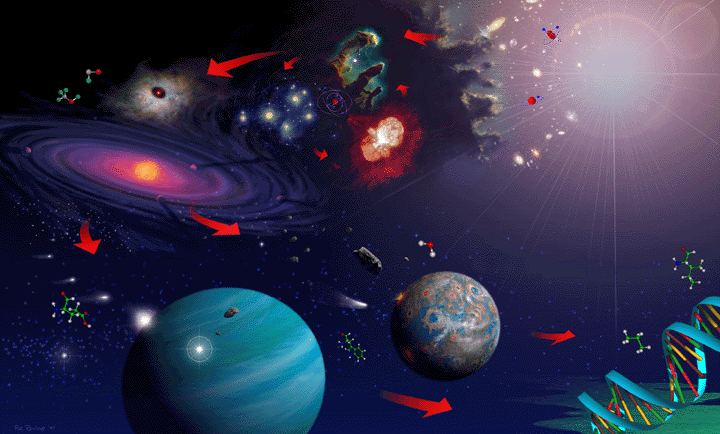
Our solar system formed about 4.6 billion years ago (abbreviated b.y.a.) when a swirling cloud of gas and dust began to contract.
In the early years after the formation of the solar system, the terrestrial planets continued to be bombarded by smaller bodies of various sizes as the last of the particulate material from the formation of the planets was swept-up by their gravitational pull.This bombardment, measured from radioactive dating of the moon's craters, and by comparing lunar, martian, and mercurian cratering records, gradually declined in intensity until it reached present-day levels about 3.5 billion years ago.
The effect of the bombardment on the origin of life was significant. Bombardment affected:
1. the temperature of the early Earth
2. the composition of the atmosphere
3. delivered biogenic elements to Earth (biogenic elements are those chemicals common to all living organisms - like phosphates)
4. Finally, the high energy released could also have delayed the origin of life.
Let's look at each of these effects in more detail:
About 3.9 bya, the earth had solidified but the violent bombardment would have prevented the continuous existence of life on the planet before 3.8 billion years ago. Large impacts would have produced globally lethal conditions by boiling large volumes of ocean water effectively sterilizing the surface of the planet with steam.
This has been called the impact frustration of the origin of life.
The interesting thing is that the oldest fossils from rocks in Greenland are about 3.8 billion years old. This means that life was existed on the planet almost as soon as it was physically possible for it to do so.

What was the atmosphere like 3.8 billion years ago?
What chemical elements were present and in what quantities? 
It turns out that the answers to these questions are also tied up with the bombardment.As the planet cooled, an atmosphere formed. When scientists initially tried to work out what was in the first atmosphere they reasoned that, because most of the matter in the solar system is hydrogen the early atmosphere of Earth must have been rich in hydrogen. Therefore, they concluded other elements (such as carbon, oxygen, nitrogen, and sulfur) would be bound to hydrogen in their reduced forms as
CH4 (methane),
NH3 (ammonia),
H2S (hydrogen sulfide), and
H2O (water)
BUT if such an atmosphere did exist it would have been blasted away by meteor impacts during the bombardment phase.
The more probable source of the atmosphere present 3.8bya would have been gases released from the cooling rocks such as we now get from volcanoes and other vents through the crust.
Based on an analysis of gases vented by modern volcanoes, it seems likely that this early atmosphere consisted mostly of water vapor (H2O) and carbon dioxide (CO2) and nitrogen gas (N2).
Note that this atmosphere is very different from the one we have today.
- Today, the atmosphere contains only about 0.03% CO2. 
- The reduction of CO2 in the atmosphere is the result of the action of living organisms. Much carbon exists today in the form of minerals rather than as CO2 in the atmosphere. Most carbonate minerals are remains of skeletons of once-living organisms.
2. Where did the oxygen come from? -Photosynthesis

3. Nitrogen on early Earth would have been at approximately its same percentage as Earth's present atmosphere.
4. Trace amounts of hydrogen(H)methane (CH4)hydrogen sulfide(H2S)hydrogen cyanide(HCN), and formaldehyde(CH2O) would have been present.

As the Earth cooled, water vapor condensed as rain and formed oceans and seas.
In addition to an atmosphere very different from the one we know, lightning, volcanic activity (crust thiner), and ultraviolet radiation (no ozone) were much more intense when the Earth was young.


What Was the Origin Of Complex Organic Molecules?

We are going to make an assumption: the chemical components found in all living prokaryotic and eukaryotic cells was present in the ancestral organism from which all life derived. In other words: the spontaneous interaction of the molecules present in the early earth's atmosphere formed more complex organic molecules, such as amino acids, sugars, fatty acids, and nitrogen bases - the building blocks of life as we know it today.As these organic compounds accumulated they formed an "organic soup" in which additional reactions could take place.
The energy needed to drive the formation of these organic molecules was derived from the sun's radiation, electrical discharges in the form of lightening, and heat from the cooling earth.

Synthesizing the Chemical Components of Living Organisms

Important point - Laboratory simulations cannot establish that the kind of chemical evolution that has been described here actually created life on primordial earth, but only that some of the key steps could have happened.

Proteins
Proteins are made up of subunits, called amino acids so we must first talk about how to make amino acids.
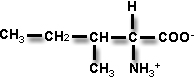
There are 20 different types of amino acids used in living organisms, but all have the same central structure consisting of a carboxyl group (COO-), an amino group (NH3), and a carbon with a hydrogen and a variable side chain. For example:
Alanine:


Isoleucine:


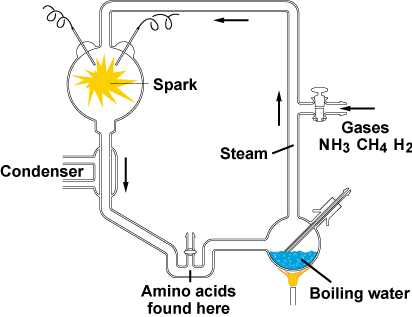
1953 experiment by Stanley Miller. While a graduate student at the University of Chicago, Miller began work to test the Oparin-Haldane hypothesis by creating laboratory conditions comparable to those of the early Earth.First he created a "comic strip version" of primitive Earth.
In a flask he put:
1. water (for the primeval sea), 
2. methane (CH3), ammonia (NH3), and hydrogen for the atmosphere (note there is no O2 no CO2). 
3. He sealed it off and exposed it to sparks for lightning and other forms of high energy such as UV radiation and heat (from Earth's interior) 
4. A condenser cooled the atmosphere, raining water and any dissolved compound back into the flask (= the sea).


After one week, Miller analyzed the contents of the solution and found a variety of organic compounds, including molecules such as formaldehyde (O-CH2)

This molecule continues to react to form formic and then acetic acid (CH3-COOH) 

Eventually the experiment yielded amino acids:For example, Adding an amino group (in other words an ammonia) to acetic acid and you have an amino acid glycine:

But getting from amino acids to proteins is difficult:

1. Amino acids are asymmetrical molecules that exist in right and left-handed forms that are mirror images of each other: the L-isomer and the D-isomer. When amino acids are made in the laboratory a mixture of L- and D-amino acids is found. However, the amino acids present in living organisms are all L-isomers. Why? How?

To see the difference between L- and D- isomers of amino acids, visit this web site: http://www.johnkyrk.com/aminoacid.html

2. To make a protein, the amino acids attach COOH end of one to the NH3 end of another. To do so, they must lose a molecule of water. Amino acids aren't likely to link up with one another and form such chains on their own and the reaction rarely happens spontaneously. Furthermore, it is unlikely that a water-producing reaction would occur if the amino acids are in water. (Remember: In the living cell, specific enzymes catalyze these dehydration reactions. But we don't have enzymes yet!)Perhaps organic polymers were synthesized and accumulated on rock or clay surfaces. If the conditions are hot and dry enough, the water molecule can be lost and amino acids can join.
Using this process, Sidney Fox and his research group at the University of Miami have formed substances like proteins, called protenoids, by drying warm mixtures of amino acids. They suggest that volcanic activity could have generated high temperature to form proteins on the early Earth, even if only temporarily and locally. It is possible to imagine waves or rain splashing dilute solutions of chemicals onto fresh lava or other hot rocks on the early earth and then rinsing proteinoids back into the water.
Problem with this idea: High temperatures pose a problem, because organic molecules tend to break down as they are heated.
An alternative idea suggests that clay, even cool clay, may have been used. Clay has some interesting properties:
1. It has a slight charge that can attract and hold other molecules.
2. Clays may contained small amounts of metal atoms, such as copper, iron, or zinc. These metal atoms function as catalysts facilitating the dehydration reactions that link amino acids together.
3. Clay also seems to be able to store energy absorbed from radioactive decay and then discharged this energy at times when the clay changes temperature or degree of dehydration.
One more problem: Proteins are twisted or folded to form a macromolecule with a specific comformation, or three-dimensional shape. This comformation determines the function of the protein. For example, the unique shape of an enzyme permits it to "recognize" and act on the substance it regulates. The shape of the molecule is determined by the order of amino acids in the chain -- how do we get the very precise order of amino acids in early earth's environment?
2. Nucleotides and Nucleic Acids
Each nucleotide is composed of 5-carbon sugar, a nitrogen containing base (and by that I mean either a single ring called a pyrimidine or a double ring called a purine)
and a phosphate group

There are three kinds of nucleotide-based molecules:

a. Adenosine phosphates - such as ATP (Adenosine triphosphate) - the energy carrier used by the cell.
b. Nucleoside coenzymes - such as NAD+ and others that transport hydrogen atoms and electrons during metabolism.
c. Nucleic Acids - responsible for the storage transmission and translation of genetic information. Such as Deoxyribonucleic acid (DNA) and ribonucleic acid (RNA).
Considering the atmosphere of the primitive earth to have contained water vapor, carbon dioxide, carbon monoxide, methane, and ammonia and/or nitrogen, then in the presence of an energy source, such as sunlight or lightning, a number of small molecules like hydrogen cyanide, HCN, are formed. These then undergo spontaneous reaction with other HCN molecules, again in the presence of some energy source and produce adenine and guanine bases (often abbreviated A and G) easily. The other two common bases, cytosine (C) and uracil (U), can also be formed in such experiments, although with more difficulty.
The next step is to combine the nucleotides with other chemicals to make more complex structures like RNA and DNA. For RNA, for example, the adenine or guanine has to be attached to the sugar molecule called ribose and a phosphate group. Ribose and other sugars can be synthesized in the lab from the molecules present in the early earth's atmosphere.
Phosphate is, however, a problem - phosphates appear to have been rare on early Earth.

3. Simple Sugars and Carbohydrates
Most cells use carbohydrates directly or indirectly for energy and as major structural materials. Carbohydrates are monomers or polymers of a sugar. A sugar is composed of carbon, hydrogen, oxygen in a 1:2:1 ratio.
4. Fatty Acids and Lipids
Lipids, which function in the storage of energy and are key components of cell structures such as membranes, are mostly composed of fatty acids.
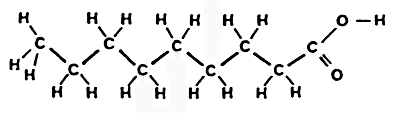
Fatty acids can be formed simply by adding several carbons to acetic acid. A fatty acid is a long unbranched hydrocarbon with a carboxyl group (-COOH) at the end:


Extraterrestrial Organic SynthesisIt is possible that some organic compounds reached the early earth from space - this is called panspermia.


In 1969, a meteor struck near Murchinson, Australia. Analysis of the meteorite fragments revealed the presence of a variety of organic molecules including amino acids, pyrimidines, and molecules resembling fatty acids. Initially, there were even serious proposals that the organic material was biogenic in origin, but consensus was soon reached that abiotic chemical synthesis was the most plausible explanation.
This is significant for two reasons:
1. Heavy bombardment of meteors could have delivered a significant amount of essential compounds to the surface of the Earth.2. The fact that these compounds could appear under abiotic, extraterrestrial conditions makes it seem more likely that similar compounds had been able to form on the primitive Earth.
We don't know yet how much organic matter was supplied to the oceans by natural synthesis on Earth and how much by meteor infall. That ratio is not as important as the fact that the right materials were present on the earth for further reactions to act on.


The Evolution Of Cell Membranes

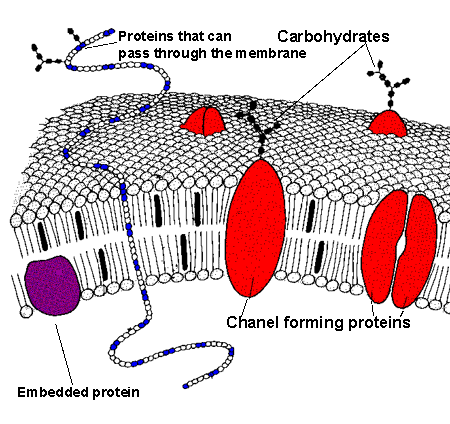
All life on this planet is cellular life. All cells are bounded by membranes that encapsulate the macromolecular machinery of the life process. How did the first membrane structures on Earth appear?Cell membranes of all living organisms contain hydrocarbon chains, which constitute an oil-like layer that forms a barrier between the internal and external compartments of cells. Proteins, which provide the enzymatic and transport activities that are primarily functions of membranes, are embedded in this fluid barrier. Therefore, to understand the origin of membrane structure we need to know how lipids and their hydrocarbon moieties provide the essential barrier properties of membranes.
Membrane lipids are typically phospholipid molecules. One of the most common, a constituent of most membranes, is phosphatidylcholine. That just means phosphate is chemically bound to glycerol and choline. The glycerol, in turn, is linked to two fatty acids, each consisting of an acidic carboxyl group (-COOH) attached to a long hydrocarbon chain. other common membrane phospholipids include phosphatidylethanolamine and phosphatidylserine.
Because they are relatively complex, phospholipids probably did not form the earliest membranes. Do molecules simpler than phospholipids assemble into membranes?
Certain molecular structures are polar, with relatively strong electrical charges expressed by their component atoms; others are nonpolar. Polar structures tend to be soluble in water and are usually referred to as hydrophilic. Nonpolar structures are hydrophobic; that is they tend to be soluble in oil and not in water. Some compounds (particularly lipids) that have both hydrophilic and hydrophobic residues on the same molecules are referred to as amohiphilic.
Hydrocarbons, by themselves, are nonpolar molecules. However, if oxygen is added to a long hydrocarbon chain, the molecules become amphiphilic, since oxygen is typically polar. All lipids have oxygen in their molecular structure, usually as carboxyl and phosphate - oxygen containing groups, chemically linked to nonpolar hydrocarbon chains.
Self-assembly of Lipids into Bilayers - Amphiphilic molecules have a remarkable property: they self-assemble into stable bilayer structures. When lipid such as phosphatidylcholine is dried, for example, the lipid molecules form lamellar structures. (Lamellar means that the structure has layers of molecules.) If water is then added, water molecules penetrate between the lipid layers along hydrophilic planes, causing the lipid to swell. The swelling produces a variety of fairly stable structures such as lipid cylinders, each of which contains thousands of concentric lipid bilayers.
Why do lipid components form a stable bilayer structure in an aqueous environment? For thermodynamic reasons. Hydrocarbon chains can't dissolve in water, and oil do not mix. When lipid molecules are placed in water their hydrocarbon chains tend to stay in contact with one another away from the water. This tendency, which is called the hydrophobic effect, stabilizes the bilayer structure.
If lipid remains in contact with water, stable spherical structures called liposomes form. Liposomes represent a good model for the first types of membranes to appear in the origin-of life saga.
The first cells required some mechanism by which a membrane could encapsulate a system of replicating macromolecules. Although this seems difficult, the drying-wetting procedure offers an easy solution. If membrane-forming lipids are dried in the presence of large molecules, the molecules are sandwiched between alternating lipid bilayers. Upon rehydration, a substantial fraction of the the molecule are encapsulated within vesicular membrane structures. This has the additional advantage of concentrating molecules from dilute solutions. A primary function of amphiphilic compounds is to provide closed microenvironments. If macro molecular catalytic-information system were encapsulated within a vesicular membrane, the components of the system would share the same microenvironment. This would be a step towards true cellular function. Encapsulation would also produce individuals; each cell would be different from its neighbors.
A second role of early membranes was probably related to energy production, because energy-yielding processes are necessary to provide for growth of the catalytic-information system. In contemporary cells, membranes are central to energy production. Chloroplast membranes capture light energy by means of embedded pigment systems. The chemiosmotic synthesis of ATP that takes place on membranes.
That is there are cell membranes - selectively permeable membranes separating metabolic pathways from the outside environment.
The basic structure of a cell membrane is phospholipid bilayer with proteins dispersed and embedded in it:


There are various simple ways to get lipid bilayers -- the problem is ingetting the proteins embedded into them:


The Origin Of Heredity

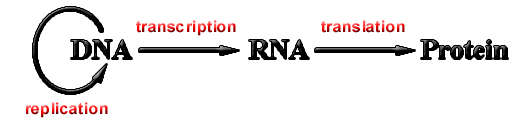
Laboratory simulations and the presence of organic molecules in stony meteorites indicate normal chemical processes could give rise to aggregates of organic molecules that are reminiscent of the molecular components of organisms. But a key problem remains - these aggregates pf organic molecules have a limited time of existence. They will eventually deteriorate and break down. Once they are gone, chemical processes are the only mechanism we have described to produce more. Making that enormous jump from chemical evolution to real organisms requires a mechanism for these systems to reproduce themselves - some mechanism of heredity that would pass along not just key molecules but also instructions for making more of these molecules. If we can solve this problem we will have solved one of the great mysteries of the origin of life.Clues to the origin of life are not easy to find when looking at contemporary organisms. In all contemporary cells, the information about how to build proteins (which, in turn, either catalyze the production of or makeup key structures) is encoded in the double helix of deoxyribonucleic acid (DNA). That information is copied when it is transcribed into a molecule of ribonucleic acid (RNA). Then translated into a particular sequence of amino acids that make up a polypeptide chain. When the chain is folded it becomes a protein. The function of that protein (becoming part of a structure or performing some metabolic catalysis) is determined by the specific type and order of the amino acids in the polypeptide chain. The order in which the amino acids are strung together is crucial because it determines how the chains will fold and twist into the three-dimensional shapes of individual proteins. On the molecular level in contemporary cells, reproduction, then, is the replication of the DNA (since this molecule encodes all of the information of life) when the cell divides.
But here is the problem - when we look at modern organisms, we see that DNA cannot replicate itself, but must be copied by specific enzymes. These replication proteins, in turn, are controlled by the transcription and translation of the DNA. If proteins are necessary to reproduce DNA but to produce proteins we need DNA, which came first in evolution? DNA or proteins?

This chicken and egg problem has puzzled scientists for some time. At first it seemed as if proteins came first. After all, proteins are so fundamental to life, they seemed to some the necessary first step in the evolution of life. As we have seen, this hypothesis is supported by the fact that the building blocks of proteins, amino acids, are relatively easy to produce in laboratory simulations of prebiotic evolution. Sidney Fox has demonstrated that it is possible to assemble these amino acids into polypeptide chains and protenoids. But to be effective as biological structures or enzymes, proteins must have a very specific sequence of amino acids. If by some enormous stroke, a single copy of an effective protein spontaneously arose, it would be a dead end. Even if successfully assembled, proteins have no way of copying themselves. they cannot replicate themselves and pass on information about how to make more of their specific structure.A. G. Cairns proposed a possible solution in the early 1980s. he suggested that naturally occurring microscopic mineral crystals in clays might have served as the basis for replication until the time when nucleic acids evolved and took over the function of replication. Clay microcrystals consist of flat plates of silicate lattices with regular arrays of ionic sites occupied by various metals. When such a crystal is contained in a droplet of water, the metal ions form irregular patterns of electrostatic potential that can attract particular molecules to the surfaces of the lattice and catalyze chemical reactions. Which reactions are catalyzed depends upon the precise arrangement of the metal ions. Molecules synthesized in this manner could be released back to the water. Because a crystal grows by incorporating silicate and metal ions from the surrounding water, the new materials are similar in composition to the original parts of the crystal that generated them. Thus crystals could, in principle, both replicate information and transfer it to other molecules. What is uncertain is whether they could have done so with sufficient precision to serve as a basis for the evolution of life. According to this theory, the clay lattice first directed the synthesis of primitive enzymes. For a long time, the clay crystals functioned as primitive genetic material, but at some point, by as yet unspecified mechanisms, RNA evolved and took over the role of replicating and transferring information. Once RNA appeared, it was so much better as a genetic material that clay-based life was quickly out competed by RNA-based life and driven to extinction. This scenario is plausible, but critical experiments to test some of its key assumptions have not yet been performed.

Ribozymes 

Gerald Joyce's lab at Scripts Research Institute in La Jolla California were working with synthetic RNAs. At first they thought the snippet of RNA had ruined their experiment. But this piece of RNA proved to be unusually talented. Within an hour of its formation, it had commandeered the proteins in the test tube and started making copies of itself. Before long, the copies began to make copies. Another piece of the puzzle was in place:RNA + proteins made by inorganic processes cause the RNA to replicate and begin to produce proteins
Finally DNA favored because easier to repair.


Summary and Conclusion

Could this happen today? Probably not. Oparin and Haldane suggested that the early earth's environment contained the correct conditions and precursors to create the basic building blocks of life. They reasoned that this cannot happen in the modern world because the present atmosphere is rich in oxygen produced by photosynthetic life. The oxidizing atmosphere of today is not conducive to the spontaneous synthesis of complex molecules because the oxygen attacks chemical bonds, extracting electrons.But having the molecules of life is not the same as having a life form. However prebiotic chemicals accumulated, polymerized, and eventually reproduced, the leap from an aggregate of molecules that reproduces to even the simplest prokaryotic cell is immense and must have taken many smaller evolutionary steps.